












Nigeria has long been regarded as one of the most football-loving nations in the world. Many fans even describe the country as the “Brazil of Africa” because of its deep passion for the game. Over the years, Nigeria has invested in building football stadiums that reflect the high standards and popularity of football played across the nation.
In this article, Softfootball reviews the football stadiums in Nigeria, highlighting their seating capacities and whether they are used by the national team or local club sides.
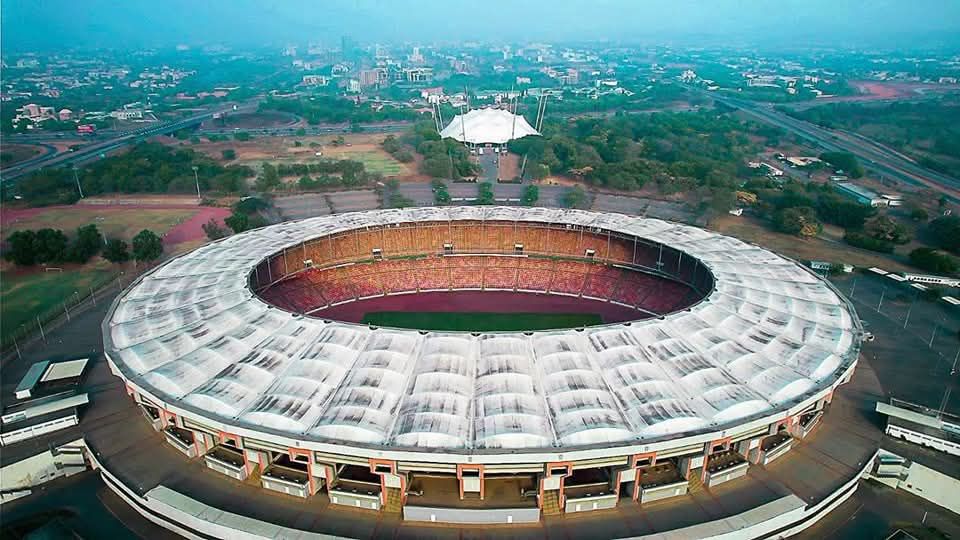
Mashood Abiola National Stadium
The Mashood Abiola National Stadium has a seating capacity of 60,491, making it the largest stadium in Nigeria by capacity. It was constructed during the administration of former Nigerian President Olusegun Obasanjo between 2000 and 2003, specifically to host the 8th All-Africa Games.

The stadium was formerly known as the Abuja National Stadium before being renamed in honor of Chief Mashood Abiola.
Traditionally, the Mashood Abiola National Stadium is regarded as the home ground of the Nigerian national team. However, due to years of poor maintenance, the Super Eagles no longer use it regularly. Instead, the national team now plays most of its home matches at the Godswill Akpabio International Stadium in Akwa Ibom State.
Jos International Stadium
The Jos International Stadium is located in Plateau State, with its site in the state capital, Jos. Construction of the stadium began in 1988, and it has remained under development for several decades, making it one of the longest-running stadium projects in Nigeria.

The proposed seating capacity of the Jos International Stadium is approximately 60,000 spectators. Despite not being fully completed to modern international standards, the stadium is still actively used and serves as the home ground of Plateau United Football Club, one of Nigeria’s most successful domestic teams.
Lagos International Stadium
The Lagos International Stadium, popularly known as the National Stadium, Surulere, was once the primary home of the Nigerian national team. It served this role until the completion of the Mashood Abiola National Stadium in Abuja, after which the national team relocated to the newer and more modern facility due to its improved features and infrastructure.

Constructed in 1972, the Lagos International Stadium is one of Nigeria’s most historic football venues. It notably hosted the 1980 Africa Cup of Nations, a tournament Nigeria won for the first time in its history. At the time of its construction, the stadium had an initial seating capacity of 55,000 spectators.
Despite its rich history and significance in Nigerian football, the stadium has suffered from years of neglect and limited renovation, which has reduced its role in hosting major international matches in recent times.
Adokiye Amiesimaka Stadium
The Adokiye Amiesimaka Stadium is one of the most modern football stadiums in Nigeria. It was officially commissioned in July 2015 and serves as the home ground of Rivers United Football Club, one of the leading clubs in the Nigeria Premier Football League (NPFL).

The stadium reflects the identity of Port Harcourt and Rivers State, featuring a distinctive blue roof that represents the state’s official colors, along with impressive architectural designs. Its modern facilities and aesthetic appeal make it one of the best stadiums currently used in the NPFL.
The Adokiye Amiesimaka Stadium has an estimated seating capacity of about 40,000 spectators, providing a vibrant and intimidating atmosphere for home matches.
Muhammadu Dikko Stadium
The Muhammadu Dikko Stadium is located in Katsina State, in the northern part of Nigeria. Katsina is also the home state of Nigeria’s former president, the late Muhammadu Buhari. The stadium serves as the home ground of Katsina United FC, the state’s professional football club.

Construction of the stadium spanned several decades, beginning in the early 1990s and reaching completion in 2013. Originally known as the Karkanda Stadium, the venue was renamed in 2016 in honor of Muhammadu Dikko, a prominent 20th-century Emir of Katsina.
The Muhammadu Dikko Stadium has an estimated seating capacity of around 30,000 spectators and is one of the key football venues in northern Nigeria.
Godswill Akpabio International Stadium
The Godswill Akpabio International Stadium is widely referred to as the “Allianz Arena of Nigeria” due to its striking architectural resemblance to the Allianz Arena in Munich, Germany, home of Bayern Munich.
Currently, this stadium serves as the primary home venue of the Super Eagles, as it is considered the most fit-for-purpose and well-maintained stadium in Nigeria at this time. Its modern facilities, quality pitch, and overall infrastructure meet international standards, making it the preferred choice for major national team matches.

The stadium is located in Uyo, Akwa Ibom State, and was constructed during the tenure of former state governor Godswill Akpabio, after whom the stadium is named. Construction was carried out by Julius Berger Nigeria between 2012 and 2014.
The Godswill Akpabio International Stadium has a seating capacity of 30,000 spectators and remains one of the most iconic sports venues in Africa.
Confluence Stadium
Confluence Stadium is located in Kogi State, Nigeria, a region famously known as the Confluence State because it is where Nigeria’s two major rivers—the River Niger and River Benue—meet. This unique geographical feature gives the stadium its name.

The stadium has a seating capacity of approximately 25,000 spectators and was constructed in 1998. It serves as one of the key sporting venues in the state.
Currently, Confluence Stadium is used as the home ground of Naija Tornadoes FC, hosting their domestic league matches and other football-related events. The stadium remains an important center for football development and sporting activities in the region.
In conclusion, Nigeria’s passion for football is clearly reflected in the scale and ambition of its stadium infrastructure. From the Mashood Abiola National Stadium, which remains the largest in the country by capacity, to the historic yet unfinished Jos International Stadium, these venues symbolize both Nigeria’s footballing potential and its infrastructural challenges.
While some stadiums were built to international standards and intended to serve as permanent homes for the national team, issues such as poor maintenance, delayed completion, and inconsistent upgrades have reduced their full utilization. As a result, the Nigerian national team has shifted to better-maintained venues like the Godswill Akpabio International Stadium, which currently offers a more suitable environment for international matches.
Overall, Nigeria possesses the foundation for world-class football infrastructure. With proper maintenance, completion of long-abandoned projects, and consistent investment, these stadiums can once again meet global standards and fully support the country’s status as one of Africa’s greatest football-loving nations.