











The question of whether John Obi Mikel could bench the current Moisés Caicedo at Chelsea is a complex one—and the honest answer is yes and no, depending on how the comparison is framed.
Softfootball gathered, From a defensive and positional discipline standpoint, Mikel remains one of the finest holding midfielders Chelsea have ever had. His ability to read the game, shield the back four, and mark intelligently was elite.
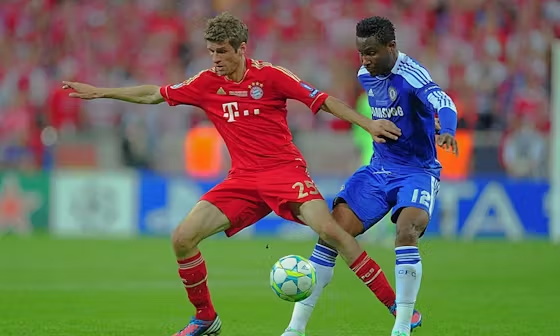
This was evident in the 2012 UEFA Champions League final against Bayern Munich, where many players struggled under pressure, but Mikel stood out as one of Chelsea’s most visible and composed performers. He was arguably among the top four Chelsea players on the night, excelling when it mattered most.
When it comes to long-range passing and tactical intelligence, there is little doubt that Mikel was exceptional. He controlled tempo, broke opposition transitions, and played with maturity well beyond his years.
However, Moisés Caicedo brings a different profile to Chelsea’s midfield. Defensively, Caicedo can mark, press, and recover at a level comparable to Mikel. Where he edges ahead is going forward.
Unlike Mikel who was deployed strictly as a deep-lying number six with limited attacking freedom, Caicedo has the license to advance, contribute to build-up play, shoot from range, and even chip in with goals.

Caicedo’s energy, mobility, and shooting accuracy suit the demands of modern football, where midfielders are expected to be complete and dynamic rather than purely positional.
This comparison does not diminish Mikel’s quality. Instead, it highlights how tactical roles and football evolution shape player responsibilities. In Mikel’s era, discipline and structure were paramount. In today’s Chelsea, versatility and attacking contribution are equally essential.
In short, Mikel would thrive in certain systems, while Caicedo fits the modern game perfectly. Whether one benches the other depends entirely on the manager’s philosophy, not a lack of quality from either player.